
S Y
INSIGHT
An app to track your therapy progress and daily mental health
.png)
Roles
-
UX researcher
-
UX|UI designer
Responsibilities
-
User research
-
Wireframing
-
Prototyping
-
Usability testing
Time constraint
-
3 weeks
What
-
Mobile app (iOS)
Therapy clients are often dealing with symptoms or disorders that can cause brain fog and/or forgetfulness. A lot goes on in just one therapy session, and it can feel overwhelming to try to remember everything. To solve this common problem, I created an app that therapy clients can use to track their therapy progress as well as their daily moods and symptoms.
What's the problem?

A common issue many therapy clients experience is being forgetful of therapy progress. Often, people who attend therapy struggle with mental health disorders that can cause them to experience brain fog and/or forgetfulness.
A lot goes on in just one therapy session, and it can feel overwhelming to try to remember everything. Forgetting important information, lessons, or thoughts from therapy sessions can be frustrating for the client and hinder them from making progress.

Here's the solution
We designed an app that:
-
Tracks daily mood/symptoms
-
Tracks therapy progress with personal notes
-
Is protected and secure
The Design Process

For my design process, I utilize the Double Diamond Design model. This design model follows the stages: Discover, Define, Develop, Deliver. Using this process allows me to fully understand the problem and come up with creative solutions.
Discover
To kick off the Discover phase, I completed SWOT analysis' on two mental health apps: Ascendant Tracker and MindDoc


User Research
For my user research, I created a survey for therapy clients. I received 29 responses in the 48 hours it was available. Some important highlights from the survey results were:
-
84% were between the ages of 25-35
-
62% said they have difficulty remembering previous sessions
-
70% said they would like to track their daily moods
-
52% attend bi-weekly
-
36% attend weekly
-
12% attend once a month
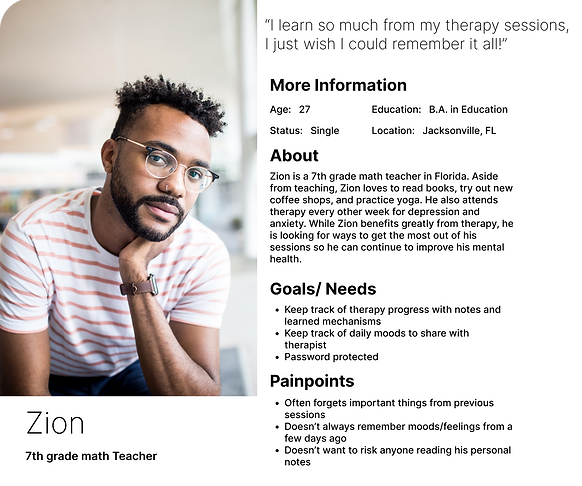
User Persona
Define
Now that we have discovered who the user is and their needs, it's time to put that information to use and define the project.
To kick off the Define phase, we start with our user stories.
-
As a client, I want to keep track of my progress so I can get the most out of my therapy sessions.
-
As someone who is forgetful, I want to keep track of my daily moods so I can discuss them in therapy.
-
As a client, I want to be able to share notes and progress with my therapist so she can update her care plan accordingly.
User Flow

With the needs outlined in the user stories, I created a user flow that meets the needs while being simple to use.
Wireframe Sketches

With the user flow created, we can now move onto sketching out the lo-fi wireframes in a crazy 8's exercise
Lo-fi Wireframes

Using Figma, I created Lo-fi wireframes. Doing this allowed me to visualize my app without getting too caught up on the visual details, such as color, just yet.
Develop
Now that we have the skeleton finished, it's time to move onto the develop phase. This is where we bring to life everything we have worked on.
I began to work on the UI aspect of the project and created a high fidelity prototype.

Brand Development
Because this app is focused on therapy and mental health, it was important to me to make the feel of the app a peaceful one. For the color palette, I decided on a mix of pinks, purple, and blues to give it a more playful and relaxing atmosphere.
For the fonts, I wanted to lean more towards a fun one to match the feelings from the color palette. I went with the Alegreya font, using Alegreya Sans as the main typeface.


The logo and graphics were made to go along with the playful theme of the app. I chose to use the Alegria art style to convey the playful and fun feelings via illustrations.



Usability Testing & Iterations
With my research I was able to create a prototype and conduct usability testing with 4 participants. Each participant was able to successfully navigate the prototype and I received valuable feedback outlined below.
Strengths
-
User friendly
-
Secured with face ID
-
Detail-oriented
Weaknesses
-
No mood mapping
-
No areas for significant events
-
Text in boxes disappear
With the feedback, I moved the titles outside of the boxes so they would remain there after written in. This helps the client know what was being asked when they look back on their notes.


Another iteration I made after receiving feedback was to add a section where clients could add events that significantly affected their mental health, negative or positive.
The last iteration I made was adding a separate page that tracks the client’s daily mental health.

Final Thoughts
My app, Insight, offers therapy clients relief when it comes to tracking their progress. It is user friendly and keeps everything organized.
For further development of Insight, I would like to make a version for therapists to use. They would be able to keep track of their notes on each client as well as connect with their clients via Insight so they can independently track their session progress and mental health.